

 Jeffrey Aronson
On Valentine’s Day all thoughts turn to romance. In automotive terms, my ’66 Series IIA 88” SW, the QE I, has captured my heart. At age 60, she’s “Forever Young” (with apologies to Bob Dylan). Her history deserves retelling.
In 1991, I determined that my changes in my work would take me all over New England, in all weather and road conditions. My ’78 Triumph Spitfire baulked at deep snow and its exhaust would get hung up if an earthworm raised its head on a dirt road. I needed a more rugged and capable British vehicle — a Land Rover.
In those ancient times, you searched for vehicles in classified ads in newspapers, used car publications like Uncle Henry’s and Autotrader, word of mouth, or scouring “For Sale” signs on the side of the road. On a Spitfire drive through Marlborough, NH, during a work trip, I spotted an old Land Rover dealer sign affixed to a shabby building that housed “Cheshire Motors.” Their printed brochure described their “Shooting Brake,” which consisted of a transformative paint job and a set of handmade gun drawers set into the rear tub of a Series Land Rover.
I stopped and ogled the donor Land Rovers in front. One was a Sage Green IIA with a safari top; its interior and exterior hinted strongly of a life of hard work and epic adventure. I asked for a test drive. The dealer principal looked dismissively at the Spitfire and wondered out loud if I knew how to double-clutch. “The brakes need some work,” he said, as he hooked up a jump starter to fire up the engine. He drove it a short while, and with reluctance, allowed me to take the helm on some dirt trails. Completely smitten, I promised to return in two weeks with a deposit.
I held up my end of the deal, but within those two weeks, he had sold the safari top (“They fetch a good price,” he explained) and replaced it with a hardtop. As he refused to reduce the asking price, I kept looking for my first Land Rover.
I turned to word of mouth and connected with a man who emulated James Garner’s “Scrounger” in The Great Escape. Ron always knew someone who knew someone who had a Land Rover for sale. To experience driving a Land Rover, I “rented” Ron and his Land Rover — with the world’s noisiest Fairey Overdrive — for a full day of driving from Maine to Cape Cod, MA, to look at Land Rovers. The results included a very straight, well-maintained late Series IIA [appropriately priced but way above my limited budget] and a lower-priced Series III with a rotten center crossmember that hinted of other issues. The experience wasn’t a waste, however; the fact that the tatty “rented” Land Rover drove a several hundred miles without a problem gave me the confidence that an old Land Rover could serve as my work vehicle.
Not long after, Ron arranged with a friend (nicknamed “The Terminator” by enthusiasts) to have his Series IIA brought to his property. On a warm, sunny day, I gave it a 15-minute test drive at 15 mph on farm fields, pronounced it perfect, and bought it. (The honeymoon was brief; on the drizzly day I drove it home the wipers, directionals and instruments failed to operate.)
The QE I came to me with 111,000 indicated miles; 35 years later, it has traveled a documented 560,000 miles. When the oil consumption rose to 80 miles per quart, forcing me to buy oil by the case, I realized the need for major engine surgery. By the time I factored in my overall mechanical aptitude, the parts cost and machine shop work, I realized that a Rovers North rebuilt engine would be the more time- and cost-effective solution. Once installed, cruising speed rose to over 70 mph and oil consumption became insignificant. To this day, the QE I holds it own on the interstate.
It’s gone through one transmission rebuild, one replacement transmission and two clutch kits (or more accurately, pressure plates, as the clutch plates showed hardly any wear.) The QE I has survived assaults by a randy horse looking for a one-night stand, and a deer making a poor judgement crossing a road at night. That latter accident prompted East Coast Rover, Rockland, ME, to examine the Rover and pronounce last rites on the frame. Rovers North came to the rescue in 2004 with a “Roverhaul” performed by the ECR team, including a galvanized frame, new front and rear suspensions, brake systems, wiring harness, even a new paint job! On a cold January day, I picked it up and immediately put it to work with a 180-mile drive.
None of the expert work and Genuine Parts included a replacement alternator. Twenty miles from my destination on a desolate rural road, the QE I went aground on the side of the road. This being Maine, the AAA flatbed also died in front of the QE I. Pouring gasoline down the truck’s carburetor throat got it going again, and an alternator shipped from Rovers North competed the repair. Twenty-one years later, it’s needed another alternator, in addition to many other maintenance parts, but it starts and runs in the most bitter cold and gets me there in the most miserable weather. I quite believe that it will continue to run long after I’ll be unable to drive it.
To help me establish a dollar value for the IIA, I once asked Rovers North how much I’d spent in parts. I could hear the tech adding up subtotals, and finally he just said, “You don’t want to know.” What I do want to be certain of is that any future cemetery plot will be a least 64 inches wide, 143 inches long and 77.5 inches deep, to accommodate the QE I, too.
On a winter’s morn I stepped out of my house to run an errand when I spotted a Defender 110 L663 coming down the hilly road past my driveway. I consider myself the doyen of all Land Rovers on this island, so instead of actually doing something productive, I said “Follow that car” to myself and tailed the Defender.
I followed it to a T intersection and watched it make a left turn onto a long, dead-end road. As a fan of many private eye and police procedural, I knew to leave a few car lengths between us. Although the Defender had Maine license plates, the fact it slowed down at scenic points on the drive suggested that the occupants lived off island.
The end of the dirt road forced the driver to stop and point himself in the right direction. I stopped my Land Rover in the middle of the road and approached the Defender. I realized that if a shabbily dressed man ran towards me on a rural dirt road with a demonic smile and his vehicle blocking mine, I might think Scary Movie or Deliverance.
Apparently, the driver thought the same as he looked reluctant to lower his window. I’m not certain my explanation comforted Jason and Ashley Crouse, Huntington Beach, CA, very much, but Jason explained that he and his wife had flown to Portland, ME, to check out this 2020 Defender 110 that they had found on Cars.com. It had relatively low mileage, a dealer maintenance record and an acceptable asking price. They had bought it and decided to tour Maine before shipping it home, which is how they wound up accosted by a strange guy on a dead-end dirt road. I felt quite guilty about the intrusion, so I took them to a few hidden waterfront locations.
Automotive purists might insist that the sounds of a well-tuned motor, the whine of a transmission and the rumble of tires on the road constitute the finest of “sound systems,” but contemporary consumers demand audio equipment replicating concert-hall levels of quality.
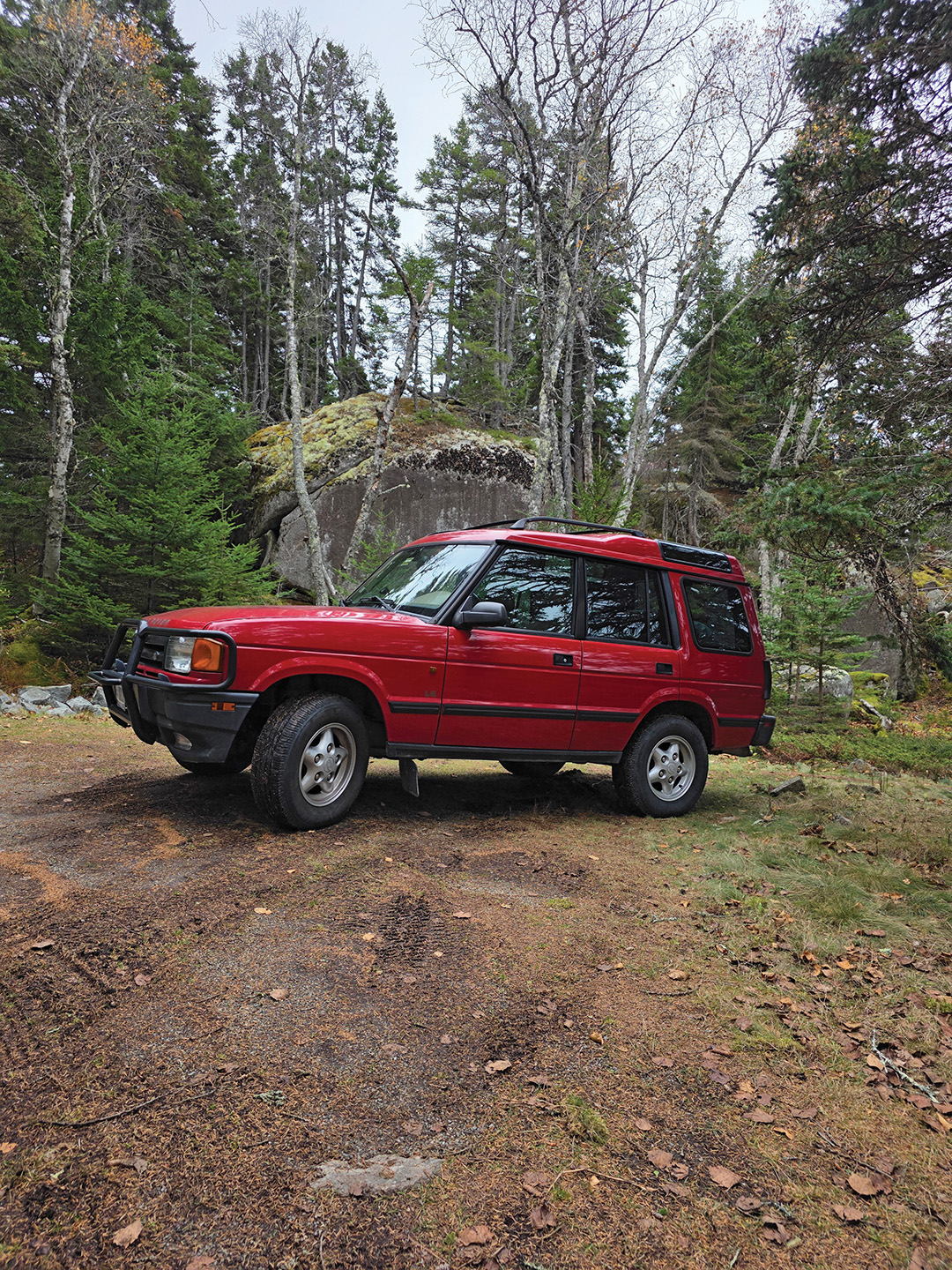
While driving my ’98 Discovery I on a mainland highway, I marveled that the AM-FM-Cassette-Weather radio still worked after all these years, or more accurately (with apologies to Paul Simon), it’s “still crazy after all these years.”
Remember your 90s cellphone? Like my old Nokia, the AM-FM radio’s screen features letters and numbers in fonts stolen from a daisy-wheel printer, in fading colors of black against a bilious green background. At night, the face screen reminds this EMT of signs of jaundice. Turning it on this winter, the radio emits a stuttering static sound that only goes away when the interior warms up. That’s not its only quirk.
To combat the scourge of radio thefts in the ‘90s, Land Rover’s radios required that each unit have a unique 5-digit code that you would need to re-enter if removing the radio (for theft or repair) or disconnecting the battery, as instructed in the manual for most any repair work. The secret code came on a card that accompanied the faux-leather bound Owner’s Manual. Lose the card and you’re out of luck, particularly with a 28-year-old vehicle.
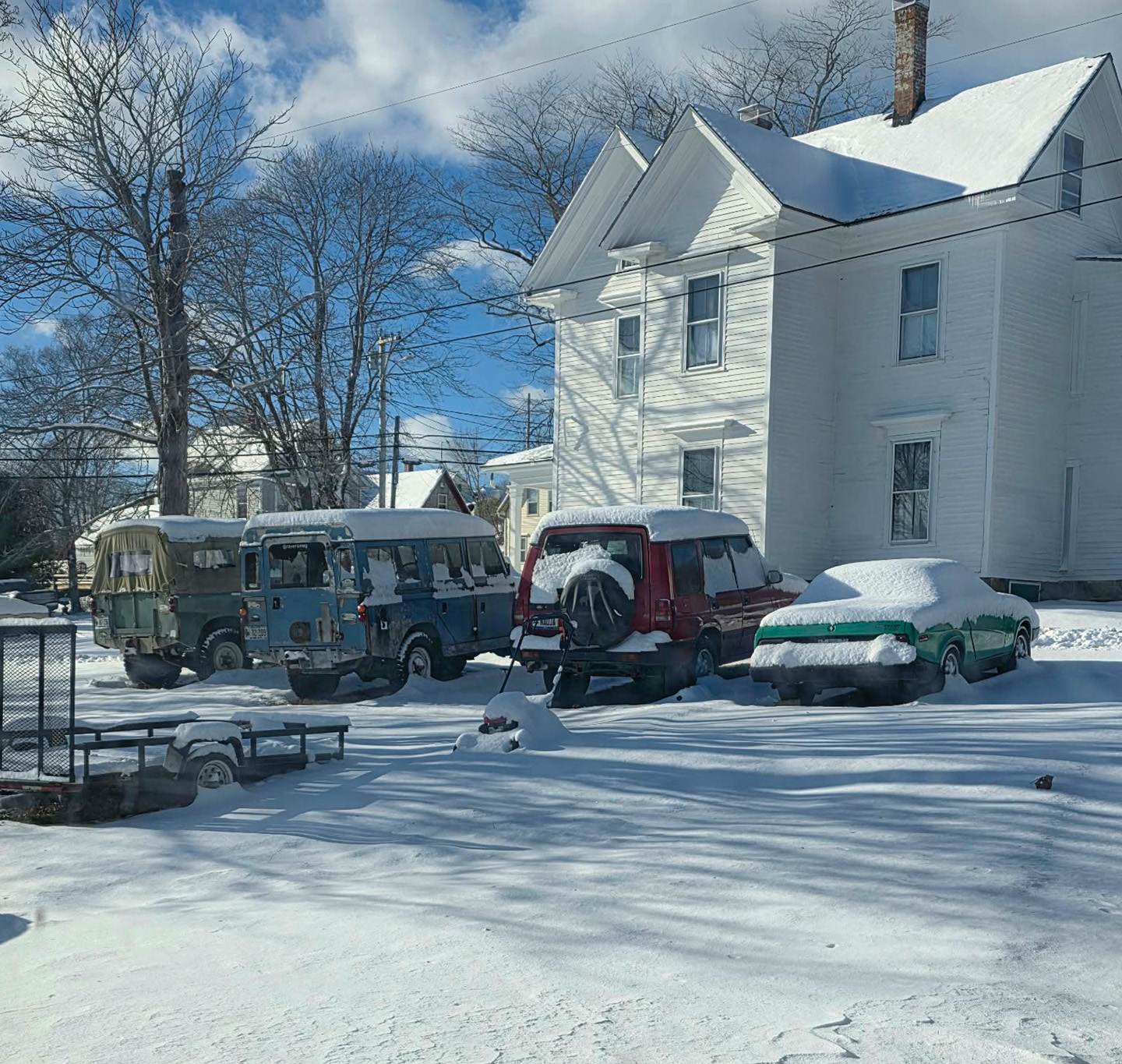
Every time I disconnect or change out the battery I have to monkey with the required Code Entry, which the radio accepts or not depending on its mood. Land Rover recognized that it had a baffling system by noting, in the Owner’s Manual, that if the radio beeps at you as you enter the code, you must not complete the entry but wait for one hour while the engine runs or the ignition remains “on” — never a good idea. I live on an island so small that its longest end-to-end points don’t require a one-hour drive. As I still recoil over the Discovery’s fuel mileage, leaving it idling is unacceptable. It took a trip on the mainland to exceed one hour of driving, and then suddenly, the radio accepted the code and now works.
Even though I only have an SE edition, the Discovery’s first owner in California went crazy with the option sheet and ordered a CD player.
It sits underneath the passenger’s seat, hidden from view by a plastic door, one easily dislodged by a passenger kicking it with their foot. Resetting the door was how I found the CD player at all; now, I’m searching for any cassettes or CDs in the house. I just might have to continue singing to myself while driving.
[Read about the “Rover-Haul” at eastcoastrover.com under “Articles”- ed.]